Top Signs You Need Garage Door Service – Don’t Ignore These
A garage door rarely fails without warning. It groans, hesitates, drifts, or makes a sound you can’t quite place, and most of us file that under “it’s fine for now.” The three clearest signs you need garage door service in Alexandria are a door that moves unevenly or hesitates before opening, a noise that’s changed from the usual hum, and a door that reverses or won’t close completely. Each one points to a specific part inside the system that’s wearing out. If you’d rather have a specialist look than guess, call (844) 681-5326.
What follows is a symptom-by-symptom translation. Not a checklist to make you nervous, but an explanation of what each warning sign is actually telling you about the spring, cable, track, or opener working behind the panels. Once you know the cause, the decision about whether to call is a lot easier.
Why a “Hesitant” Door Is a Spring Problem, Not a Sluggish One
A door that pauses for a second or two before it starts moving isn’t lazy. That hesitation is the opener motor doing extra work it wasn’t built to do. Springs carry most of the door’s weight; the opener is only supposed to guide it. When spring tension weakens or falls out of balance, the motor compensates by pulling harder, and every cycle shaves life off the drive gear and motor in ways that add up over months of daily use.
Here’s what makes this worth checking early. A tired spring keeps working, just less well, so the door still opens and you keep putting it off. Then the hesitation gets longer, or the door starts reversing a few inches off the floor and you assume the sensor is dirty. In our experience, by that point the spring has usually lost a real amount of its lift capacity. Springs don’t regain tension; they only weaken. The fix is a spring replacement, and it’s far less involved than replacing an opener burned out from months of overwork.
This is also the point where people ask about adjusting the spring themselves. We’ll be direct: garage door springs are under extreme tension, and the torsion type can cause serious injury if a homeowner tries to loosen or wind one without the right tools and training. Spring failure is a job for a specialist. A trained technician can read the tension, tell you whether one spring or a matched pair needs replacing, and get the door balanced again safely. That’s a big part of what we do in Alexandria, and it’s the highest-risk repair on the whole door for a reason.
If you’ve noticed the hesitation, it’s the right time to book garage door repair rather than wait for the spring to break outright at a moment that’s inconvenient.
What Changed Noise Tells You About the Failing Part
New noises are the most diagnostically useful symptom a garage door produces, and most homeowners tune them out. That’s a mistake, because the type of sound points to the part that’s wearing. Learn to listen and you can describe the problem to a technician before they arrive, which shortens the whole visit.
- Grinding or a metal-on-metal scrape: usually worn rollers or a dry, misaligned track. The metal surfaces are grinding against each other instead of rolling cleanly. Left alone, this wears the track and can cause the door to jump.
- A sharp pop or bang, followed by a door that won’t lift: this is the classic sound of a torsion spring breaking. Stop using the door. The opener can’t safely lift a door with no spring support, and the door can drop.
- A rattle that’s new, or a section gap you can see: loose hinges or fasteners, or panels that have shifted. Gaps let a panel flex when the door moves, and flexing over time can crack a section.
- A high-pitched squeal from the ceiling unit: a dry or worn opener gear, or a drive belt that’s stretching. On a Genie or a Wayne Dalton setup, this often traces to the opener itself rather than the door.
- A rhythmic thump each cycle: an out-of-balance door or a bent track the rollers are catching on.
None of these sounds fix themselves, and all of them get worse. A grinding noise in Alexandria in the middle of a humid stretch tends to accelerate because the metal rollers and track pick up grit faster. If the noise has changed in the last few weeks, treat it as a signal to look now, not later.
Why a Door That “Mostly Works” Is the More Dangerous One
Homeowners assume a door that’s fully dead is the urgent case, and a door that stutters but mostly closes can wait. In our experience the opposite is true. An intermittently functional door is more dangerous than a fully broken one, because a broken door stops you from using it. A door that works *most* of the time keeps inviting you to trust it, including the one time it decides not to.
This matters for three specific reasons:
- The safety reverse may be failing quietly. A door that closes on its own is relying on its safety reverse feature to stop and reopen if something’s in the way. When that feature drifts out of adjustment, the door still looks fine, but it’s no longer protecting what’s beneath it.
- A weakened spring can let the door drop. If the spring is failing but not yet broken, the door can free-fall part-way when the opener releases. A door that “mostly” works is one that can fail mid-travel.
- Cable wear goes unseen. A fraying cable works until it doesn’t. The first sign is usually a snap, and a snapped cable on a loaded door can whip.
This is why we treat intermittently-working doors as worth an urgent look rather than a casual one. If your door in Alexandria is doing something it shouldn’t, even occasionally, that’s the door to check. garage door opener repair covers the opener and safety-reverse side; the spring and cable side falls to our repair service. Both are worth getting ahead of instead of waiting for that one cycle where the door refuses to move.
Seasonal Trouble Spots for Alexandria Doors
Humidity swings between summer and winter in Alexandria put two different kinds of stress on a garage door, and each season tends to surface its own failures. Knowing what to check at each change of season gets you ahead of the problem rather than reacting to it.
Late summer into fall. The humid months work against the wooden panel doors common on some Clopay and Amarr models, since repeated moisture uptake causes sections to swell and warp slightly. That warping throws the door out of balance and can make it rub the track. The dry season that follows can dry out the wood and open small cracks. Check for sections that look bowed or a door that no longer sits flush when closed.
Winter into spring. Cold nights stiffen the grease in the tracks, rollers, and opener gears, which is often when a marginal opener finally struggles to lift the door. It’s also when a spring that’s been quietly weakening all year gives up. Check for a door that lifts slowly on the first cold morning, or one that won’t open at all after a cold night.
Every season change, check two things: the safety reverse (put an object under the closing door and confirm it reverses), and the balance test below. Both take a few seconds and tell you more than staring at the door from the driveway ever will. Doors on a LiftMaster or Chamberlain opener can log some faults in the wall unit’s diagnostics, but the physical checks are the real test.
The 30-Second Balance Test That Tells You If a Call Is Urgent
You don’t need tools to know whether your spring tension is off. There’s a quick, safe check any homeowner can do without touching a spring, a cable, or any moving part under tension.
- Close the door and pull the emergency release cord hanging from the opener rail. This disconnects the opener so the door moves by hand.
- Lift the door partway by the handle to about waist height, then let go gently.
- Watch what it does. A properly balanced door should stay roughly where you left it, held by its springs. A door that drops is under-supported; a door that drifts upward on its own is over-tensioned.
If the door fell or drifted, re-engage the opener before using it, and treat the tension as a service issue. Don’t try to adjust the springs yourself; that’s the one part of the door you should never put your hands on. A correct balance test takes seconds and quietly answers the question every homeowner asks: can this wait, or not?
We see this in Alexandria all the time. People who run the balance test tend to catch failures early, while the door is still opening, rather than after it has. If yours fails the test, the door needs a look. To schedule one, garage door installation is what we’d discuss if the system is worn past the point where repair makes sense, and our repair service if it isn’t.
When to Call a Pro
Some symptoms are “call when you get a chance,” and some are “stop using the door and call today.” Here’s how we split them.
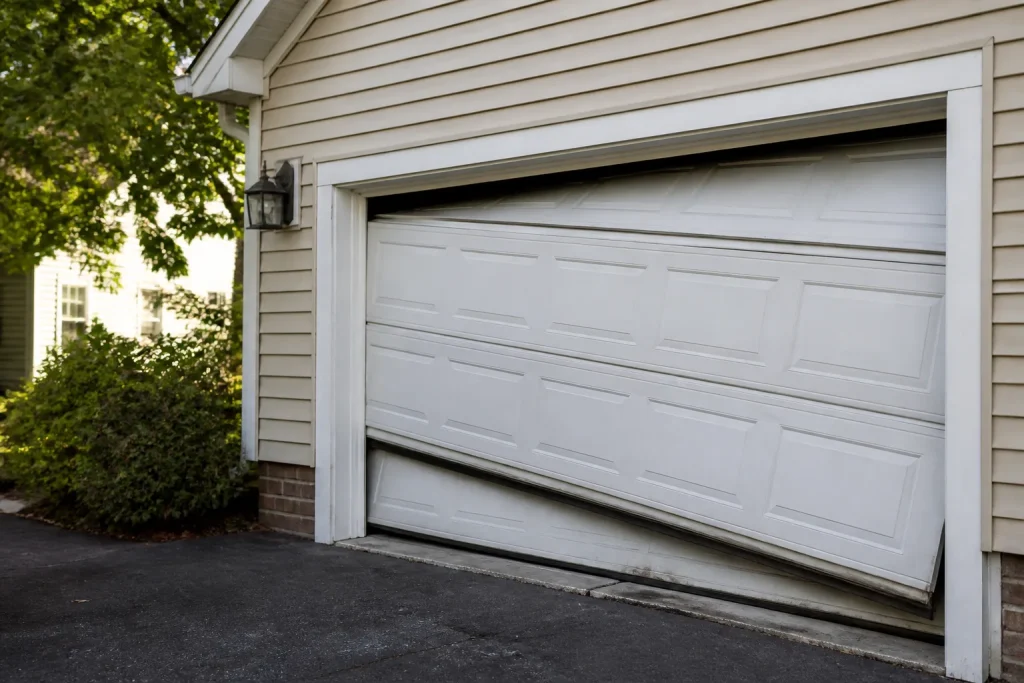
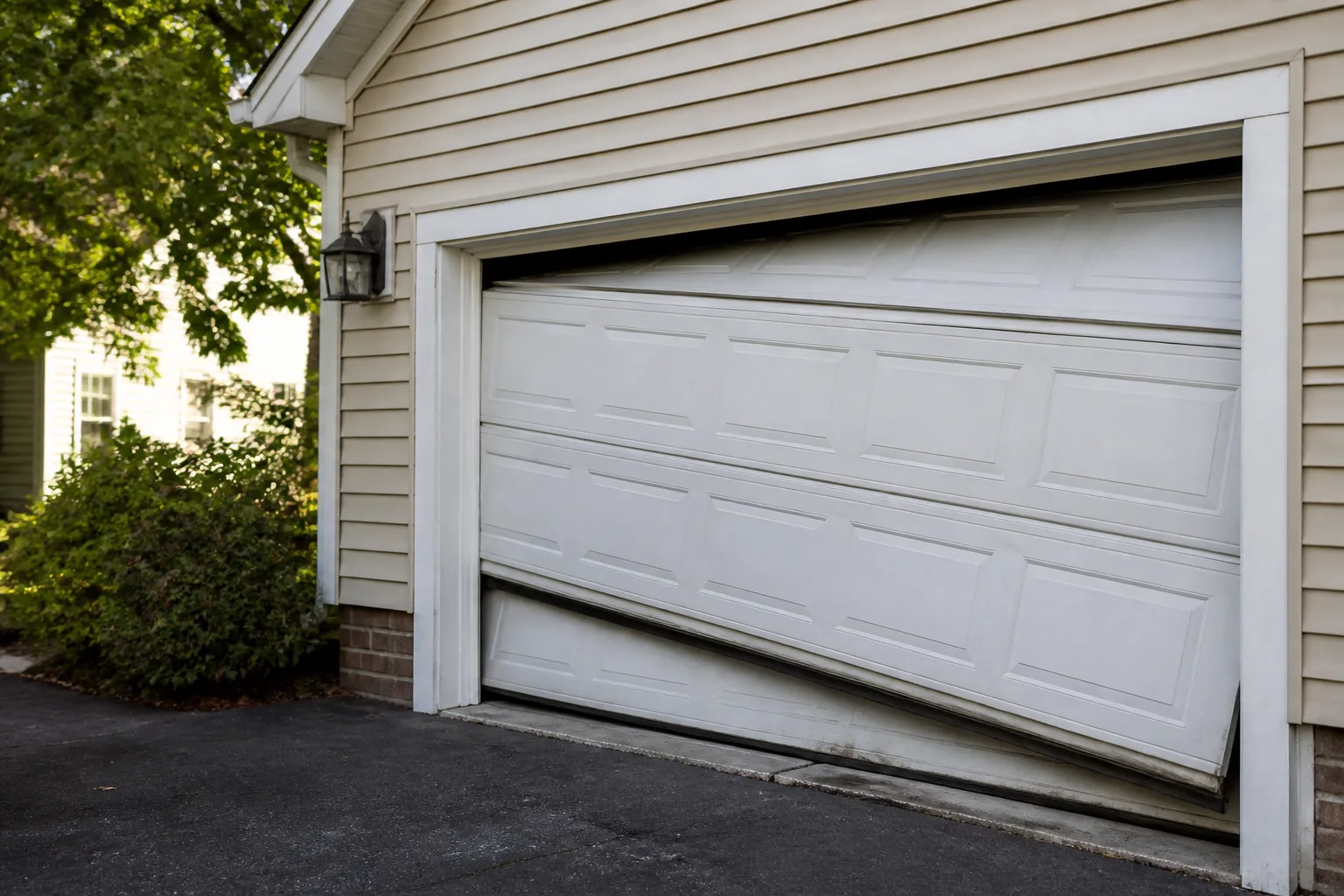
Call today, and stop cycling the door: a snapped spring (no tension, door is heavy), a frayed or snapped cable, a door hanging off its track, a door that reverses or won’t stay closed, or any grinding that’s become a metal-on-metal scrape. These are the cases where the door can drop or fall. When it won’t open and your day can’t wait, our emergency service is there for exactly that, since a door stuck open is a security gap as much as a broken door.
Book within the week: a hesitant start, a new noise that comes and goes, a door that fails the balance test but still opens, or a safety reverse that needs checking. Any of these can be handled without drama if you don’t let it slide.
We work on the two smart-home-integrated opener families most Alexandria homes run, LiftMaster and Chamberlain, along with legacy Craftsman and Genie systems, so there’s no guesswork about your hardware. From the opener to the panel to the spring, we cover it in a single visit. Same door, fixed right, whenever possible, before replacement even comes up.
Related services in Alexandria: Alexandria Garage Door Repair Co handles the full range, from spring and opener work to new installations.
The Bottom Line
Every warning sign on a garage door has a mechanical cause behind it. Hesitation means the spring is tired and the opener is compensating. A changed noise tells you which part is wearing. A door that “mostly works” is the one to worry about, because it’s still inviting you to trust it. The balance test takes half a minute and gives you a real answer about urgency. If you’re in Alexandria and any of this sounds familiar, get it looked at while it’s a repair and not a scramble. Alexandria Garage Door Repair Co offers free estimates – call (844) 681-5326 and we’ll give you an honest read on what your door actually needs.
Frequently Asked Questions
A door that hesitates before opening, a noise that’s changed from the usual hum, and a door that reverses or won’t close completely are the first signs, along with a door that fails the balance test. Each one points to a specific part (spring, cable, rollers, or opener) that’s wearing, so catching it early keeps a repair from turning into a replacement.
Not directly from the speed, but a slow-moving door often means the spring has weakened and the opener is overworking, which can lead to a door that drops or an opener that fails. An intermittently working door is more dangerous than a fully broken one because it keeps getting used. Have it checked before the spring gives out.
A sharp pop or bang followed by a door that won’t lift usually means a torsion spring has broken. Stop using the door and call for service, since the opener can’t safely support the door without the spring. Grinding sounds point instead to rollers or track, and a new rattle to loose hinges or panel gaps.
Yes. Pull the emergency release cord, lift the door partway to about waist height, and let go. A balanced door stays roughly where you left it; one that drops or drifts means the tension is off and it needs a professional look. Don’t adjust the springs yourself, since they’re under extreme tension. For an exact quote on getting it fixed, call (844) 681-5326 – estimates are free.
Written by the team at Alexandria Garage Door Repair Co.
Need Garage Door Help?
Call Alexandria Garage Door Repair Co - the local pro we connect you with is licensed and insured, here with fast after-hours help in Alexandria.
(844) 681-5326